13 October, 2013

Ab-normal Beauty


Sei mong se jun (2004), South Korea

Director : Oxide Pang
Produced : Pang Brothers

Synopsis
Ab-normal Beauty describes the story of Jin, an extremely talented arts student and photographer who finds herself with no inspiration in her work, seeking for what she defines as the ideal picture. After witnessing a car crash, the main character discovers to have a fascination with death, as she enthusiastically starts photographing the accident. At this moment, the viewer is promptly introduced to an obsession that the main character will eventually have to face along with the tumultuous repressed memories from her past.


Review
Ab-normal Beauty is a psychological horror film that explores the abnormal obsession and repressed memories of Jin, a perfectionist photographer with a troubled past and a clear lack of communication with her often absent mother. The first two thirds of the movie describe Jin’s growing obsession with death and an initial struggle to face the memories of a past traumatic sexual event, with sporadic moments of bizarre and aggressive violence that illustrate Jin’s disconnection from the reality. Race Wong does a proper work with her lead role as, interestingly enough, her real life sister Rosanne plays her lesbian girlfriend Jas. It is in fact the presence and comfort in Jas that ultimately appears to allow the main character to overcome her macabre obsession. In the last third of the movie, Jin finds herself back in a Lost Highway, when a videotape is left at her front door containing images of a brutal murder. The last half hour is thus unexpectedly feed with gruesome moments, explicit violence (that may be considered atypical in the Pang brothers’s filmography), voyeurism, masturbation and even auto-erotic asphyxiation. The scenes may somehow seem to be displaced to the viewer, yet their purpose is well placed in the movie as the unknown murderer appears to represent the extremely masculinized figure representing Jin's fear of being victimized by men.


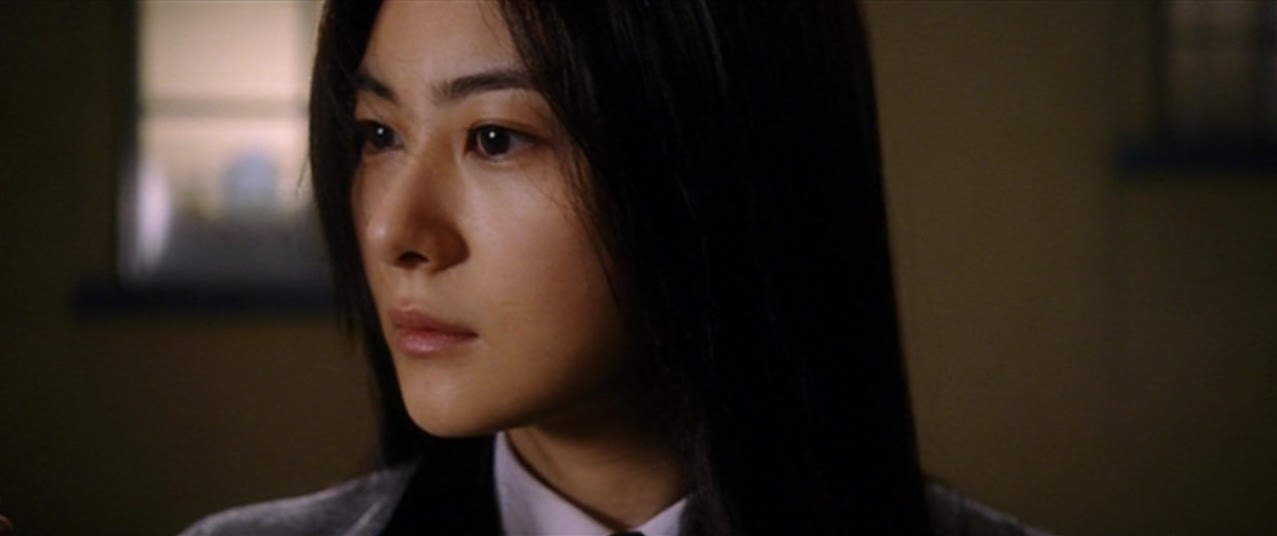
While the argument appears to draw on contours of the biographical drama of a tortured artist who seems to find a bizarre beauty in a pile of decapitated chickens or in the corpse of a dog, unexpectedly followed by half hour of unpredicted violence, and whether or not the end really works, the viewer is expected to keep in mind that, all in all, Ab-normal Beauty shall be seen as a journey in which the main character is allowed to overpass her traumatic sexual experience. The character development at some point seems to be particularly accelerated during the first two thirds of the movie, as nothing much appears to occur. The peculiar fascination for death could have been developed in a much proper way, appearing to be, at some points, rushed and meaningless and not as deeper as the director would have wished. The film is beautifully filmed as expected from the Pang Brothers, the art and the use of red during the filming are particularly stunning, with a few brilliant moments such as the balcony scene, and others left to interpretation as the bath’s scene (cf. screenshot above). All in all, the film definitely has a few strong elements although it seems obvious that the director could have better exploited their potential. Accordingly, Ab-normal Beauty is without a doubt not comparable to The Eye for those seeking for similar experiences by the Pang brothers, although it remains a particularly interesting effort of Oxide Pang.

03 December, 2012

Re-Cycle


Gwai wik (2006), Hong Kong

Synopsis
Re-Cycle is one of the mostly well-achieved works of the Pang brothers (Danny and Oxide Pang), screened at the 2006 Cannes Film Festival. The film describes the story of a successful writer Tsui Ting-Yin (Angelica Lee) who founds herself with no inspiration for her new novel (entitled Re-Cycle), after writing one best-seller based on her own personal experiences. Battling against writer’s block and an obstinate publisher, her attempts to start the book appear to become even more dissipated with the reappearance of her former boyfriend after his divorce. After discarding a draft of the first chapter of the new book, a series of incidents start to happen in her own apartment, including mysterious phone calls and a few frightening elements that the Pang Brothers have previously proven to master.


Review
Until the release of Re-Cycle, the directors appeared to have struggled for a few years in order to achieve the same success obtained with The Eye. Following the predictable The Eye 2 and the absurd The Eye 10, Re-Cycle was mostly likely expected to continuously repeat the same formula and scares that have guaranteed before the success of the Pang Brothers. Therefore, when elements of The Eye, Dark Water and Ringu started to appear, I truly believed that Re-Cycle would most likely turned out to be just another unoriginal installment of the “series” and a new 108-minutes exercise of patience. The first thirty minutes, classifiable as tedious and predictable, have therefore comprised the supernatural long-haired woman cliché, the scene inside a lift as previously observed in The Eye, mysterious sounds from the other side of the phone, water running down walls, figures, shadows and endless calculable scares. Hopefully after thirty minutes the viewer is introduced to a new world in the Pang brothers’ universe and to a new series of elements where the viewer can no longer distinguish the line between horror and fantasy, leaving behind the concept of another (effortlessly created) ghost story.


From a technical point of view, the Pang Brothers have clearly surpassed themselves. Alongside with the plot, and Lee’s performance, the explosion of visual effects are the undoubtedly the third pillar of the movie. Visually superb, with a rich use of colour and a thin line between the opaque monochromatic tones and a few extremely saturated moments (as the screenshots above and below respectively demonstrate), Re-cycle is probably the most brilliantly masterpiece achieved by the Pang brothers in the technical field. Despite the vast number of events during the movie, the plot is conducted in a particularly slow pace up to the very end of the film. Angelica Lee is the main character of the film, delivering a particularly convincing and satisfactory performance, with only a few smaller roles being present during the whole movie. The character development follows the same path as the plot itself, which tends to be important when the movie depends on only one character. 


Re-cycle is still a good movie especially if one is able to disregard the exacerbated number of similar elements that are presented in the same movie. For someone who is not particularly familiarized with the directors’ universe, the Pang Brothers will prove to be genuinely competent in the Asian horror scene, providing a couple of particularly suspenseful and nerve-racking scenes. The movie is however able to write a conclusion for the successful formula that was pitifully dragged for too long after the release of The Eye.

Three... Extremes


Saam Gaang yi (2004), Hong Kong, South Korea, Japan

Synopsis
Three… Extremes is an Asian cross-cultural trilogy of horror films from three accomplished Asian directors of three different Asian countries. The movie is the second installment of the proposed series of two films, following its particularly well-achieved antecessor Three (2002). From the point of view of the viewer, Three...Extremes (or Three, Monster) had for objective to provide an improved installment of three segments, a task considered to be partly complicated given the many brilliant elements present in the previous compilation, but in the other hand plausibly realistic given the inexistent balance that Three failed to find. Three…Extremes comprises as indicated before three segments: Dumplings by Fruit Chan (Hong Kong), Cut by Park Chan-Wook (South Korea) and Box by Takashi Miike (Japan). With the movie clearly intended to heavily rely on two of the most promising names in the current Asian horror scene, Three... Extremes would be considered to be clearly superior, achieving the success that Three was never able to attain. The movie clearly reaches for the extreme that exists within the viewer, for our greatest fears, obsessions, repulsions, superbly bringing out the worst inside every single human being.

Review
Dumplings is the first segment of the film, introducing the viewer to the story of Mrs. Lee (Miriam Yeung), an aging movie star who has long ago lost the attention of her husband and has therefore decided to visit Aunt Mei (Bai Ling), an old woman who still has the looks of her youth due to a secret disturbing and gruesome ingredient in her own dumplings recipe. For those who are not familiarized with the work of Fruit Chan, up to the movie release and with the exception of the present segment, the director's filmography predominantly considered particularly uninteresting plots with prostitution and other problems of the modern Hong Kong society as its main backgrounds. Dumplings starts promptly, with the viewer being introduced in the first five minutes of the film, to the special ingredient in Aunt Mei’s dumplings recipes.  The director clearly does not fear to shock the viewer, being at this precise point that Fruit Chain clearly reinvents himself. Still focusing in previously developed work, with a dark satire of elements of the Hong Kong society, Dumpling provides a noteworthy clin d'oeil to a large range of social issues such as incest, the gap between social classes, the detrimental obsession with youth, immigration and clandestine abortions.  A brilliant nerve-racking soundtrack by Chan Kwong-wing is accompanied by a veritable parade of disturbing sounds and noises orchestrating a disquieting atmosphere, giving the film a tremendously well-achieved audible character and surely providing a constant feeling of repulsion. A 90-minute version of the segment was released in the same year, with a different twist at the end, and allowing Fruit Chan to explore a high number of elements that were somehow undervalued in the short story.


Cut describes the story of a filmmaker (Lee Byung-hun) kidnapped by a figurant/extra (Lim Won-hee) of a few of his previous movies, to whom is given the opportunity of saving his wife (Gang Hye-jung) by killing an innocent child. The genius previously observed in Park Chan-wook work (Sympathy for Mr Vengeance, Sympathy for Lady Vengeance, Oldboy) is once more registered in the present brilliantly executed segment. The film follows in a distorted "quest for revenge" schema, reminding the viewer in some ways of the Vengeance Trilogy of the same director. Based upon a surrealistic reality, the film is most likely defined as an unclear voyage inside the mind of the protagonist, into an intriguing environment of uncertainty and terror where, beyond psychosis, the existing sporadic humor (particularly displaced and absurd), only leads to further confusion. Visually stunning and with a correct use of colour and light, Cut includes a few creatively executed scenarios, although for the majority of the movie, the action is claustrophobically confined to one single set. Cut culminates beautifully in a fatal climax, where the reality and the reality that the protagonist appears to see collapse in an abysmal emotional density. The short film is without a doubt a brilliant masterpiece and considered to be the best segment of the trilogy.


Kyoko (Kyoko Kasegawa) is a writer tormented by the accidental death of her twin sister, when they both had only ten years old. One day, the main protagonist discovers in her desk an invitation for a meeting in the exact same place where her sister died. The work of the controversial director Takashi Miike is long (Audition, Ichi the Killer, Visitor Q), shining in a considerably large range of themes. The film mixes in a particularly exacerbated way dream and reality, tending to be somehow confusing, and giving the viewer a certain insecurity concerning the direction of plot. Miike succeeds however to toast the viewer with a particularly outstanding camera-work, characteristic and constantly well-achieved during the film, with a few shooting elements consistent with the final twist and interesting visual effects that generate a suffocating atmosphere due in part to the disturbing horror felt by the protagonist. All in all, I tend to believe that Box represents in some ways the filmography of Takashi Miike in one single word: irregular. Therefore, although being considered in general a satisfying concise work, Box could clearly have been developed in a more brilliant way as Takashi Miike as previously proven to be capable of.

02 December, 2012

Three


Saam Gaang (2002), South Korea, Thailand, Hong Kong

Synopsis
Three comprises three short films from three different directors of different nationalities: Memories by Jee-woon Kim (South Korea), The Wheel by Nonzee Nimibutr (Thailand) and Going Home by Peter Chan (Hong Kong), producer of the sequel The Eye. The movie is the first installment created as an international cooperation between three different Asian countries, followed two years later by the successfully acclaimed Three... Extremes. Due to the success of the later, Three is sometimes considered to be a sequel of the second movie, having even been "incorrectly" denominated as Three Extremes II.  Interestingly, each segment of both movies tends to reflect the culture of each country, its own beliefs, traditions and mysticisms.

Review
With Memories, Jee-Woon Kim demonstrates the quality that turned out to be observed a year later with the brilliantly executed A Tale of Two Sisters. The segment describes the story of a man (Bo-seok Jeong), with no recollection of the moments leading up to the sudden disappearance of his wife a few days before, and the story of an amnesic woman (Hye-su Kim), who wakes up in another part of the town, trying desperately to remember her way back home. The film is mostly a concise work, well accomplished and particularly well structured, notwithstanding the somehow predictable (but still well achieved) final twist. Competent acting, visually captivating with a beautiful camera-work and easily instilling a good sense of terror in the viewer, Memories is nonetheless slightly corrupted by an obvious (and sometimes fastidious) similarity to the film Ringu and to classic clichés of the actual Asian horror scene.


After Memories, The Wheel is somehow a clear disappointment, going far beyond from the fact that I usually tend to not particularly appreciate films where the main terror source is an evil puppet, as the present one. The segment is about an arts troupe grappling with the curse of an evil puppet that surrounds the obscure deaths of a high number of characters. Beyond the predominantly annoying poor acting during the film, The Wheel fails principally by suffocating a poor plot with exacerbated horror and dramatic elements comprising drownings, fires, asphyxiations, sudden agonizing deaths, suicides, prohibited passions, possessions and even ghosts. Tedious, The Wheel is undoubtedly the piece that does not fit in the compilation, alienating a possible smooth transition between the three short stories and becoming (after a few hilarious moments) a constant exercise of patience. The story allows however the viewer to have an interesting cultural experience of rural Thailand, introducing us to a few traditions, mysticisms and to a genre of dance drama from Thailand (Khon), being culturally the richest segment among the compilation.


“A cop searching for his missing son when he is kidnapped by a man who keeps his wife locked inside their apartment” is the premise of Going Home, which is by far the longest and clearly the most developed segment of the three stories. A grotesque love story, reaching the limits of the macabre. Clearly lacking the frightening factor and punctuated by a series of events constantly introduced in a particular slow pace, the film excels by its nature undoubtedly touching, intelligent, and with an unpredictable twist at the end for a story impeccably performed and interpreted.

01 December, 2012

Hansel & Gretel

Henjel gwa Geuretel (2007), South Korea

Synopsis 
Eun-su, a troubled young man, has a car accident in a lost mountain road. When Eun-su wakes up, he finds a mysterious girl, dressed up like Little Red Ridinghood that helps him leading him into a fairytale scenario, into her own house deep in the middle of a forest. The main character soon meets her siblings and the couple supposed to be their parents. An obvious nerve-wracking tension and a mysterious atmosphere dominant inside the house contrast with the colorful and visually detailed ambiance of each different set. The story then details each day in which Eun-su tries desperately to run away from the house, without success.


Review
Hansel and Gretel is a well-known fairytale of German origin describing the story of a young brother and sister threatened by a cannibalistic witch living in a deep forest in a house made of cake and sugar. As it is later revealed in the movie, the storyline has a direct inspiration in the fairytale itself, including several references that may therefore be observed during the film, gently reminding us of the fairytale: the house, the forest, cupcakes, cookies, cream and sugar, the bread crumbs or an adult pushed into a burning fireplace.


Although for some of us, children may represent one of the best explored scary sources in horror movies, with Hansel and Gretel, the director has decided to take a different path for a story that may not even be considered as a horror film. As soon revealed, the children have supernatural powers, punishing the bad grown-ups which continue to disappoint them. Although some scenes are particularly well achieved in the horror domains (transformation of one of the characters into a living doll or the suggestion that another character was literally cooked and eaten by the inhabitants of the house), the supernatural powers of the children are somehow poorly developed during the plot. As the film goes and the tension increases, the plot appears to take a different path becoming in a certain way a meaningful story that has something to say about the abandon and the abusive treatment of children or about the hypocrisy of Christian institutions. Hansel and Gretel is thus probably better described as a mysterious dark fantasy played safely, with strong points of interest but somehow lacking something more. 


A Blood Pledge

Yeogo goedam 5: Dong-ban-ja-sal (2009), South Korea

Synopsis
A Blood Pledge is the fifth film in the film series telling the story of four girls, Eon-joo (Jan Gyung-ah), So-yi (Son Eun-seo), Eun-young (Song Min-jeong) and Yu-jin (Oh Yeon-seo), which apparently make a collective pact to commit suicide. Although all of them seem to climb to the roof of the building, only one of the students jumps to her death. Among speculation of what actually happened, rumors of the reasons for Eon-jon's suicide and the appearance of Jeong-eon (Yoo Shin-ae) the younger sister of the victim, the story quickly seems to take its shape through the contours of the truth.


Review
Series of American films, with special emphasis on those concerning the horror genre, are usually known by their apparent tendency to repetition and rapidly exhausting the originality sometimes achieved in the first film. The series Whispering Corridors is however the opposite of this american tendency, being apparently able in five films and ten years after to keep a simple premise and combining differently terror adjacent to ghost stories.


Contrary to some of the previous films in the series, A Blood Pledge clearly proposes itself explicitly as an horror movie, investing in concrete elements supposed to scare the viewer, and limiting in an obvious way the investment in the history plot. The film follows the possibly least interesting and most generic of the arguments registered in the series, although being the first that considers the topic of group suicide among students in Korea. The characters are particularly uninteresting (especially the main protagonist and the ghost), with ineffective and exaggerated acting being often registered. The explanation of the events is done in a slow pace, with no particular final twist (as commonly observed in the current panorama of classic Asian cinema). A Blood Pledge stands out as the first film repeating obvious elements previously used in the series, recurring to a few acceptably well done scares under the clear influence of Ringu. A wide range (not guaranteeing its effectiveness) of special effects is also used, usually with an unreasonable exaggeration of blood and a few laughable moments of attempt of terror (special emphasis on an exploding head...). All in all, A Blood Pledge still provides a good entertainment, but is merely a simplistic horror movie devoid of anything even considered remotely interesting.


Voice

Yeogo gwae-dam 4: Moksori (2005), South Korea

Synopsis
Voice is the fourth installment of the proposed series of films "Yeogo gwae-dam", following the line of its predecessors whose narrative revolves around a school haunted by a former student, with the present one describing the story of Young-eon, an aspiring singer whose talent seems to be thoroughly recognized by her best friend Seon-min. However, early in the film and while practicing, Young-eon is mysteriously attacked by a supernatural force, and her body enigmatically disappears. Waking up the next morning as a ghost, Young-eon who can only count on the help of her best friend, who seems to be the only one able to hear her voice, is determined to uncover the mystery surrounding her apparent death.


Review
According to the film, after death, a ghost's voice can be kept as a way to communicate with those human beings with whom the ghost had a strong connection in life. However if the connection is weakened, then the ghost starts loosing its voice and can no longer communicate with humans, becoming invisible and inaudible. The voice does not vanish all at once, but will disappear intermittently over the course of hours and days, which can be observed during the film when the friendship between the two main characters becomes strained. The relationship between the two girls is then once again the basis of the story as previously observed in the series. Moreover, following the line of previous films (in particular Memento Mori, the second installment of the series), Voice cannot be described as an horror film although it seems to be clear that no attempts were made in that direction. On the opposite, the film is better described as a emotionally touching story about friendship and loneliness, with one of the strongest plots of the series. 


Particularly, I must confess that I was pleasantly surprised during the unfolding plot. A beautiful and talented Kim Ok-Bin at the beginning of her career (later better known for her superb performance in her role in Park Chan-Wook's Thirst) as the protagonist, surrounded by a female casting marked by competent performances during the film, flickering lights and classic lightning techniques to achieve dark contrasts, a particularly beautiful soundtrack, with the action being claustrophobically confined to just a few sets since the ghost could not leave the school ground. The movie plays with the different feelings of each character, exploring the selfishness and the altruism of Young-eon, obsession, manipulation and suicide as a consequence of being chastised in a korean high school. Moreover, Voice stands out chiefly by allowing the viewer to have a different vision of a typical ghost story movie, showing the isolation and loneliness of a ghost in its first moments after being dead, exploring the fear of being forgotten, revisiting the most meaningful moments in a ghosts life. Ultimately the film scrutinizes the many reasons of why some ghosts seem to stay among us. Revenge, the truth. Being a dog and becoming a wolf. And the one reason that eventually becomes the final twist in this film.


30 November, 2012

Dark Tales of Japan

(2004), Japan

Five japanese directors of horror films offer five different scary tales in only one film titled Dark Tales of Japan. Although announced as a work of five of the greatest directors of the J-Horror, names such as Hideo Nakata were not part of the anthology.

The opening short story, Spiderwoman, centers on a newspaper reporter who is selling a lot of magazines by reporting on numerous unconfirmed reports of a half-woman half-spider creature, always represented in a different number of ways, establishing the sense of myth surrounding her. Since most of the stories seemed to came from the same area of the city, the reporter is sent by his editor to do a follow-up story. Spiderwoman directed by the writer of Dark Water, could have been a pretty creepy story, but it just isn't. Halfway between annoying and considerably not well-done, pointed by a particular bad acting, the story culminates with a twist much more laughable than scary.

Crevices is the second segment of the movie, describing a man who has come to his friend's apartment to clean the place up after the disappearance of the latter. The landlord lets him in, only to discover the apartment has been all taped up in its every single gap with bright red masking tape. Although being probably the most scary of the segments, straight to the point and surrounding itself in a considerably creepy atmosphere, Crevices lacks nevertheless the slightest explanation of the occurrences, inflating an exaggerated acting of the protagonist due to the short duration of the story. A full-length version of the segment would have been somehow more interesting to see.


The Sacrifice describes the story of Mayu, a young woman, who seems to be stalked by her co-worker Fukuda, after rejecting him. At the same time, memories of her grandmother being eaten by the frightening apparition of a giant head, surface. The supposedly creepy character Fukuda is halfway between laughable and hilariously bad. The Sacrifice basically celebrates in a strange way a mother-daughter bond, under a mediocre pretext and a clearly underdeveloped story's plot, lacking in scares, similarly to most of the remaining segments, and slowly heading to its predictable end. 


Blonde Kwaidan is the segment directed by Takashi Shimizu (mostly known for being the creator of The Grudge), about a japanese man on a business trip to Los Angeles, who seems to have a great obsession with blondes. Funny thing, I was visiting L.A. when I first saw Dark Tales of Japan, so I must admit the first seconds of the story actually made me laugh. I probably laughed until the moment that it is proven that the main character of the segment is simply an annoying and obnoxious business man, with no further development. Terribly harmless and ineffective, the short story can indeed be considered as pretty embarrassing, without making any sense. 

Presentiment is the longest and by far the most developed segment of the five short stories. It's about a man who plans to steal some company confidential files before running away with his suicide-threatening mistress, becoming however trapped in an elevator with three very creepy looking people. Although the end seems to be quite predictable, the tension gradually rises as the film goes by. The actors performances also seem to be quite superior when compared to the ones registered in the previous stories. Possibly the most interesting of the five segments.


Effectively, Dark Tales of Japan could have been an interesting compilation of five different scary stories, but it's not the case. If you're looking for something scary with a suspense-filled plot, the five stories are not what you are looking for. Most segments make you laugh, some of them are most of the time specially annoying, becoming an exercise in patient.